
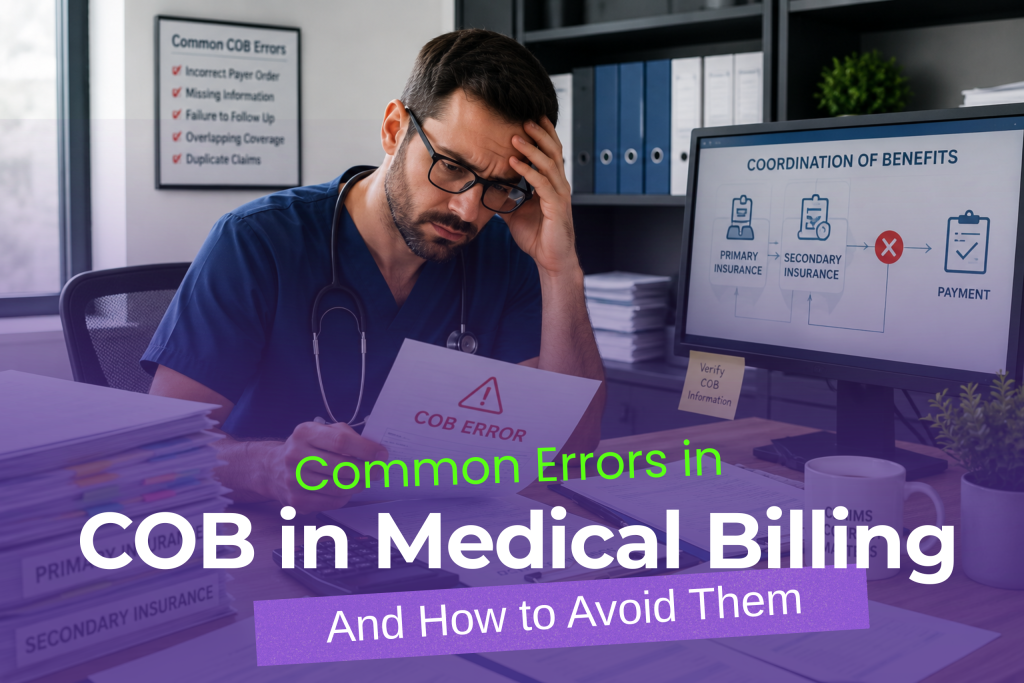
COB in medical billing causes more revenue loss than most practices realize, and the frustrating part is that the errors behind it are almost always avoidable. Coordination of Benefits mistakes do not announce themselves at submission. They surface in denial reports days or weeks later, after the correction window has already started closing and staff are already stretched across other work.
Practices that consistently struggle with COB errors in medical billing tend to share the same root problems. Not wrong intentions, but gaps in process, outdated staff knowledge, and intake steps that were never designed to catch coverage issues before they reach the claim. This guide goes through each of those gaps directly.
What Is COB in Medical Billing?
Coordination of Benefits in medical billing is the mechanism that prevents two insurers from each paying a full claim for the same service. When a patient holds more than one active plan, COB rules establish which insurer takes the primary role, which handles the remainder, and how payment responsibility is divided so total reimbursement stays within the actual billed amount.
How COB Works
Primary insurance payer handles the claim first, pays its contracted share, and passes the remaining balance forward. The secondary insurance payer then reviews what the primary paid before deciding its own contribution based on the patient’s remaining liability.
Patients with tertiary insurance coverage add a third layer to this sequence. The third plan looks at what the first two paid and covers whatever obligation remains within its own policy terms.
Why COB is Important
Primary insurance payer handles the claim first, pays its contracted share, and passes the remaining balance forward. The secondary insurance payer then reviews what the primary paid before deciding its own contribution based on the patient’s remaining liability.
Patients with tertiary insurance coverage add a third layer to this sequence. The third plan looks at what the first two paid and covers whatever obligation remains within its own policy terms.
Why COB Errors Cause Claim Problems
Increased Claim Denials
Sending a claim to the wrong payer first is one of the fastest ways to generate a denial. That payer is not set up to be first in line, and their system flags it immediately. The billing staff then has to pull the claim, fix the payer order, and resubmit, burning time on a correction that intake procedures should have prevented. Medical billing claim denials from COB errors are especially wasteful because the underlying service and coverage were both legitimate.
Delayed Reimbursements
Two to three weeks becomes six to eight weeks once a COB denial enters the correction cycle. For practices where cash flow depends on predictable payment timelines, a cluster of COB-related delays in the same month creates pressure that ripples into the next. A single billing error type should not have that much influence over monthly revenue performance.
Compliance Risks
Medicare Secondary Payer rules are federal, not advisory. Billing Medicare first when a working patient has active employer coverage is a compliance violation, not a billing inconvenience. Medical billing compliance failures in this area draw audit attention, and staff unfamiliarity with the rules is not a valid defense when those audits happen.
Revenue Loss Issues
Some COB rejections never get worked. They age in the denial queue, cross the timely filing deadline, and disappear from collectible revenue. Once that deadline passes, no payer is required to process the claim regardless of how valid the original service was. For this reason alone, practices focused on best revenue cycle management give COB denials priority status from day one.
Incorrect Primary Insurance Selection
How This Error Happens
The billing team puts the wrong plan in the primary position, and the claim goes out incorrectly. This happens most often when staff do not have a working understanding of what actually determines payer order. The birthday rule for children covered under both parents’ plans, the active employee exception under Medicare Secondary Payer rules, and how retiree coverage interacts with other plans are all areas where assumptions produce wrong answers.
Impact on Claims
Secondary payers do not process claims submitted out of turn. The claim comes back denied, and the correction process starts over with the primary payer, who now has fewer days left in the filing window than when the claim was originally submitted. Getting the payer order wrong at submission costs time in both directions.
Ways to Prevent It
Checking COB order at intake, before the appointment happens, is the correct place to catch this. Staff training needs to cover payer determination rules with enough depth that staff can apply them to real patient scenarios, not just pass a policy quiz. Working with a medical billing services team that handles multi-payer claims daily keeps these errors from reaching submission in the first place.
Outdated Patient Insurance Information
Common Data Entry Issues
Patients update their insurance constantly, and they rarely tell anyone at the provider’s office. They switch employers, their spouse changes jobs, they turn 26 and drop off a parent’s plan, or they pick up Medicare. The billing team finds none of this out until the claim returns denied because the plan on file has been inactive for three months.
Effects on Claim Approval
An eligibility denial on an otherwise clean claim is one of the more frustrating outcomes in billing. The service happened, the patient had coverage, but the claim hit the wrong carrier and came back rejected. Tracking down active plan information after the fact, updating the record, and resubmitting adds real administrative hours. When several accounts carry the same problem simultaneously, the correction backlog grows faster than it gets worked.
Verification Best Practices
Pre-visit insurance benefits verification is the correction. Checking eligibility before each appointment, not just at initial registration, catches the changes that patients never report. The time required to run that check is a fraction of what a denial and resubmission cycle costs. Making verification a scheduled step in the intake workflow rather than a manual exception removes the inconsistency.
Failure to Verify Coverage Changes
Insurance Plan Updates
A long-established patient is not a low-risk patient from a COB standpoint. Coverage changes at every open enrollment cycle, and employers switch carriers without any notification reaching the provider. Group numbers change, benefit structures shift, and new policy numbers get issued. None of that information flows automatically to the billing system. It has to be captured through active verification.
Risks of Old Coverage Data
A claim submitted with a wrong group number or outdated carrier information comes back rejected. The billing team then has to identify what changed, find the correct plan details, update the record, and resubmit. That process takes time, the denial sits in the queue while it happens, and revenue cycle performance reflects every day of that delay.
Prevention Strategies
A 90-day re-verification standard for established patients keeps coverage data from drifting too far from reality. High-frequency patients need verification at every appointment. Payer coordination breaks down when the data behind it is months old, and coverage does not flag itself as stale. The practice has to catch it through a scheduled process.
Missing Secondary Insurance Details
Common Registration Errors
Secondary coverage gets missed at registration more often than most practices track. The intake process collects the primary card and moves forward. If the patient does not volunteer information about a second plan, and nobody asks directly, the secondary coverage never makes it into the record. That gap stays invisible until the primary claim closes and there is nothing actionable for the remaining balance.
Claim Processing Delays
Secondary payer claims cannot be submitted without complete plan information. When that information was never collected, the billing team either has to contact the patient to gather it after the fact or write off the balance. Secondary payer claims represent real collectible revenue. Missing them is not a paperwork technicality.
Accurate Data Collection
Intake staff need a direct, specific question about additional coverage built into every registration, not just new patient workflows. Asking whether the patient has any other insurance besides the one already provided, including through a spouse, a retiree plan, or a government program, produces the information that secondary billing depends on. Structured intake that treats this as mandatory captures what unstructured intake misses.
Duplicate Claim Submission Errors
Why Duplicate Claims Occur
Claim tracking failures produce duplicate submissions. A denial comes in, one staff member resubmits it, and before the status updates, a second staff member submits it again from their own worklist. Automated systems retry submissions when confirmation is delayed, sometimes for claims the payer already accepted. Any gap in communication or status visibility creates the conditions for duplicates.
Consequences for Providers
The second submission gets flagged and denied. In cases where both claims process before the payer catches the duplicate, a refund demand follows. Providers who generate repeated duplicates eventually attract compliance scrutiny. Duplicate payment prevention matters beyond the individual claim because the pattern itself draws attention.
Steps to Avoid Duplicates
Checking claim status before any resubmission is the minimum requirement. Confirm the original was rejected, not still in process. Assigning single-person ownership to each denied claim with documented action records closes the gap where two people work the same claim independently. These are process controls, not software features, and they work.
Errors in COB Claim Documentation
Missing Supporting Documents
Secondary payers need the primary Explanation of Benefits to know what has already been paid before they calculate their own share. Submitting a secondary claim without that document attached gives the payer no basis for adjudication. The claim comes back as pending documentation, and the billing team has to locate the EOB, attach it, and resubmit.
Incorrect EOB Information
An EOB attached to a secondary claim still has to be accurate. A payment amount that conflicts with the primary’s records, a mismatched member ID, or a wrong adjustment code gives the secondary payer a reason to question the submission. The document needs to be reviewed before it is used, not just located and attached.
Documentation Best Practices
Pulling the primary EOB immediately after payment posts, reviewing it against the original claim details, and attaching it to the secondary submission in the same billing cycle removes the lag where documentation errors occur. A secondary claims checklist that makes EOB review a required step before submission catches both missing and inaccurate documentation before it reaches the payer.
Lack of Staff Training on COB Rules
Knowledge Gaps in Billing
COB rules are not static, and what staff learned during onboarding may not reflect what payers require today. Medicare Secondary Payer guidelines update. Individual payers adjust their coordination policies. Staff who have not received targeted COB training in the past year are likely applying rules that do not fully match current requirements, and the denials that result look like individual mistakes rather than a training gap.
Common Training Challenges
COB training gets treated as a one-time onboarding item at most practices. Experienced staff leave, new staff come in, and the knowledge transfer is informal at best. The new person follows the process as they understand it, applies the rules they were shown, and generates errors that reflect what they were never taught. Denial rates stay elevated without anyone connecting them to the training issue.
Effective Training Methods
Quarterly sessions built around real denied claims give staff the kind of grounded, scenario-based instruction that policy documents alone do not provide. Reviewing actual rejections as a team builds shared understanding and catches interpretation errors before they repeat. A practice management consulting review of current workflows identifies exactly where training gaps are producing denials and where targeted improvement will have the most impact.
Best Practices to Avoid COB Errors
Verify Insurance Regularly
Both primary and secondary plan details need to be confirmed before each appointment. Policy numbers, group numbers, payer order, and coverage dates should all be current at the time of service, not at the time of last registration. Verification before every visit turns a reactive process into a preventive one.
Use Standardized Workflows
When individual staff members handle COB steps differently, the error rate reflects those differences. A standardized process from registration through claim submission removes the variability. If the steps are the same for every patient handled by every staff member, deviations become visible and correctable rather than buried in individual working styles.
Automate Eligibility Checks
Automated medical billing insurance verification tools pull live eligibility data from payer systems and update records without requiring manual input. Changes that patients never reported show up before the appointment, not after the claim denies. For practices dealing with high volume, automation brings both accuracy and time savings that manual verification cannot match.
Conduct Internal Audits
Reviewing COB claim patterns monthly, tracing denial reasons back to their intake or submission source, gives practice leadership real data on where the process is failing. Healthcare revenue cycle management does not improve on intention alone. The practices that close their COB denial rates over time are the ones reviewing their own numbers and acting on what they find.
How Technology Improves COB Accuracy
Billing Software Benefits
Billing platforms with COB-specific pre-submission edits check payer order, flag missing secondary plan data, and identify coverage overlap before the claim reaches the payer. Catching those issues at the edit stage costs almost nothing compared to correcting them after a denial. The billing team handles fewer rejections and spends more time on productive work when the software is running those checks automatically.
Automated Verification Tools
The gap between what was collected at registration and what the payer currently has on file is where a significant portion of COB errors originate. Automated tools close that gap by retrieving current eligibility data in real time and updating patient records without manual steps. The plan information driving the claim reflects the patient’s actual current coverage, not a snapshot from six months ago.
Real-Time Eligibility Checks
Finding out about a coverage problem before the patient arrives is fundamentally different from finding out through a denial two weeks later. Real-time eligibility checks give staff the chance to collect updated plan information, adjust payer order, or flag a billing issue before it becomes a rejected claim. That upstream correction keeps rcm medical billing performance where it needs to be rather than bleeding into rework hours downstream.
Building an Effective COB Process
Patient Intake Procedures
Everything in the COB process depends on what gets captured at registration. Intake staff collect both insurance cards, confirm payer order, document the policyholder relationship for each plan, and note any secondary or tertiary coverage. Gaps at this stage do not fix themselves later in the billing workflow. The quality of the claim that goes out reflects the quality of the information collected when the patient first arrived.
Insurance Verification Steps
Verification covers current eligibility on all active plans, confirmed COB order, policy and group numbers, and effective dates. All of it gets documented in the patient record at the time it is confirmed. Insurance data accuracy at the verification stage determines whether the claim gets written correctly. There is no reliable way to compensate for poor verification data later in the process.
Ongoing Monitoring Practices
COB management does not end at submission. Claim status after submission needs active tracking, COB-related denials need same-day prioritization, and monthly denial trend reviews need to reach practice leadership with enough detail to support process decisions. Practices that monitor consistently and adjust based on patterns outperform those that only respond to individual denials. The medical billing companies with the strongest collection records treat monitoring as an operational function, not an exception task.
Conclusion
COB in medical billing errors concentrate around the same problems in practice after practice. Wrong payer order, stale insurance data, missing secondary plan details, and documentation that does not reach the secondary payer. Each problem has a process fix. Practices that build those fixes into intake, verification, and submission workflows stop managing the same denials repeatedly and start collecting the revenue they actually earned.
Frequently Asked Questions
What does COB mean?
COB stands for Coordination of Benefits. In the context of medical billing, it is the process that governs how two or more insurance plans split payment responsibility when a patient holds multiple active policies. COB rules establish which plan pays first and how each subsequent payer responds to the balance that remains after the primary has processed the claim.
Why do COB claims get denied?
Wrong primary payer selection, missing primary EOB on secondary submissions, and outdated patient insurance information account for most COB rejections. The payer receiving the claim either is not the correct first-in-line payer or does not have enough information to process its portion. In both cases, the claim comes back and has to be corrected before it can move forward.
How is primary insurance determined?
It depends on the patient’s coverage situation. A patient covered through their own employer holds that employer’s plan as primary. For a dependent child on both parents’ plans, the birthday rule designates the parent with the earlier calendar-year birthday as primary. Under Medicare Secondary Payer rules, an active employer plan generally takes primary status over Medicare when the employer has 20 or more employees on payroll.
Can COB errors delay payments?
Consistently, yes. A COB denial adds a correction and resubmission cycle that typically runs three to six weeks. If the claim is not corrected before the timely filing deadline, it becomes permanently uncollectable regardless of whether the service and coverage were both valid at the time of the visit.
How can providers prevent COB errors?
Verifying eligibility and payer order before every appointment, keeping staff trained on current COB determination rules, attaching reviewed primary EOB documentation to all secondary submissions, and auditing denial patterns monthly covers the main sources of COB errors. Practices with high claim volume and recurring COB issues often find the clearest path forward through medical billing services professionals with direct experience managing multi-payer coordination.